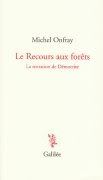
Michel Onfray: Le recours aux forêts. La tentation de Démocrite


Démocrite fut dans la Grèce antique un philosophe matérialiste fêté, qui parcourut le monde. Lors de son périple jusqu’en Inde, il a constaté la vilenie des hommes, à la suite de quoi il fit construire une petite cabane au fond de son jardin pour y finir en sage le restant de ses jours. Je nomme tentation de Démocrite et recours aux forêts ce mouvement de repli sur son âme dans un monde détestable.

Le monde d’avant-hier, c’est celui d’aujourd’hui, ce sera aussi celui de demain : les intrigues politiques, les calamités de la guerre, les jeux de pouvoir, la stratégie cynique des puissants, l’enchaînement des trahisons, la complicité de la plupart des philosophes, les gens de Dieu qui se révèlent gens du Diable, la mécanique des passions tristes – envie, jalousie, haine, ressentiment… –, le triomphe de l’injustice, le règne de la critique médiocre, la domination des renégats, le sang, les crimes, le meurtre…

Le repli sur son âme consiste à retrouver le sens de la terre, autrement dit, se réconcilier avec l’essentiel : le mouvement des astres, la logique de la course des planètes, la coïncidence avec les éléments, le rythme des saisons qui apprennent à bien mourir, l’inscription de son destin dans la nécessité de la nature.

Fatigué des misères de ce temps qui sont les ancestrales souffrances du monde, il faut planter un chêne, le regarder pousser, débiter ses planches, les voir sécher et s’en faire un cercueil dans lequel on ira prendre sa place dans la terre, c’est-à-dire dans le cosmos.

Read more...

Books of the decade (The Guardian)

The world was rocked by terrorism, climate change became an emergency, celebrity culture moved from our TVs to our bookshelves, and a boy wizard held millions spellbound. Love them or hate them, these are the 50 books that defined the decade
The books of the decade, according to The Guardian

Read more...

Gilbert Simondon: Form and Matter

Simondon, Gilbert. L’individu et sa genèse physico-biologique. Paris : Presses Universitaires de France, 1964. Original Translation by Taylor Adkins.


Read more...

Michael Hardt and Toni Negri: Common Wealth (book)

When Empire appeared in 2000, it defined the political and economic challenges of the era of globalization and, thrillingly, found in them possibilities for new and more democratic forms of social organization. Now, with Commonwealth, Michael Hardt and Antonio Negri conclude the trilogy begun with Empire and continued in Multitude, proposing an ethics of freedom for living in our common world and articulating a possible constitution for our common wealth.

Drawing on scenarios from around the globe and elucidating the themes that unite them, Hardt and Negri focus on the logic of institutions and the models of governance adequate to our understanding of a global commonwealth. They argue for the idea of the “common” to replace the opposition of private and public and the politics predicated on that opposition. Ultimately, they articulate the theoretical bases for what they call “governing the revolution.”

Though this book functions as an extension and a completion of a sustained line of Hardt and Negri’s thought, it also stands alone and is entirely accessible to readers who are not familiar with the previous works. It is certain to appeal to, challenge, and enrich the thinking of anyone interested in questions of politics and globalization.

Publisher Harvard University Press, 2009 ISBN 0674035119, 9780674035119 Length 330 pages

Link to book

Read more...

Frederic Worms: A concepção bergsoniana do tempo

Resumo

Trata-se aqui de mostrar como a filosofia de Bergson decorre da constatação da passagem do tempo enquanto fato primordial e originário; nessa medida, as suas obras podem ser consideradas como diferentes tentativas de esclarecer tal experiência da temporalidade que, filosoficamente considerada, consiste na intuição da duração. Para isso, examina-se a forma pela qual o tratamento dado a problemas filosóficos distintos e discutidos em cada um de suas obras efetiva-se como meditação sobre o fato primitivo e seu esclarecimento progressivo. Em primeiro lugar, acompanhamos o percurso de dedução das principais características da duração, sucessão, conservação e ato, sublinhando algumas de suas conseqüências filosóficas. A seguir, examinamos a dimensão crítica da filosofia de Bergson pela análise do pensamento do instante, aquele que desfigura a experiência do tempo e origina a via equivocada da metafísica tradicional; nesse exame procuramos diferenciar tal pensamento da experiência da simultaneidade, que é constitutiva de nossa relação concreta com as coisas.

The bergsonian Conception of Time
Abstract

The aim of this article is to show how Bergson´s philosophy derives from the understanding of the passing of time as an original and primordial fact. In this way, his works can be considered to be different attempts to explain this experience of temporality which, philosophically considered, consist of the intuition of duration. Thus, we examine the way in which the treatment given to distinct philosophical problems discussed in each of his works takes place as a meditation on the primitive fact and its progressive clarification. Firstly, we follow the course of deduction of the main characteristics of duration, succession, conservation and act, emphasizing some of his philosophical consequences. We then examine the critical dimension of Bergson´s philosophy through the analysis of the thought of the instant, which distorts the experience of time and gives rise to an equivocal way of traditional metaphysics; in this examination we shall seek to differentiate this idea from the experience of simultaneity that constitutes our concrete relationship with things.

Fonte, Texto Completo: PDF

Read more...

Parrhesia on Simondon

http://www.parrhesiajournal.org/

Read more...

Herman Melville: Thinkers and divers

Now, there is a something about every man elevated above mediocrity, which is, for the most part, instinctuly perceptible. This I see in Mr Emerson. And, frankly, for the sake of the argument, let us call him a fool; — then had I rather be a fool than a wise man. — I love all men who dive. Any fish can swim near the surface, but it takes a great whale to go down stairs five miles or more; & if he don’t attain the bottom, why, all the lead in Galena can’t fashion the plumet that will. I’m not talking of Mr Emerson now — but of the whole corps of thought-divers, that have been diving & coming up again with bloodshot eyes since the world began. [Letter to Evert Duyckinck, March 3 1849]

Read more...

Antonio de Guevara - Obras

Antonio de Guevara Fray Antonio de Guevara es un clásico de la filosofía escrita en lengua española. En junio de 1999 quedó dispuesta la Edición digital de las obras de Antonio de Guevara, el autor español que más influencia alcanzó durante el siglo XVI, el entonces más traducido y reeditado. De esta manera todo el mundo puede ahora disponer de forma libre y sencilla de las obras de este cántabro universal. Ofrecemos también una Bibliografía y una selección de referencias y estudios sobre Antonio de Guevara. [fonte]


Read more...

When a man govern another man

Well I doubt not that the people of Nebraska are, and will continue to be as good as the average of people elsewhere. I do not say the contrary. What I do say is, that no man is good enough to govern another man, without that other´s conset. I say this is the leading principle - the sheet anchor of American republicanism.
Abraham Lincoln

Read more...

Claude Lévi-Strauss est mort

Selon l'Ecole des hautes études en sciences sociales et son éditeur Plon, l'anthropologue et ethnologue Claude Lévi-Strauss est mort dans la nuit de samedi à dimanche. L'intellectuel, notamment auteur de Tristes Tropiques, aurait fêté ses 101 ans le 28 novembre prochain.
L'académicien avait consacré sa vie à l'étude des peuples dits "primitifs", aux symboles et aux structures de groupe. [Le Figaro]

Read more...

Jean Hyppolite (1952) The Organisation of the Logic: Being, Essence, Concept

Hegelian Logic is the absolute genesis of sense, a sense which, to itself, is its own sense, which is not opposed to the being whose sense it is, but which is sense and being simultaneously. This genesis resembles an organic growth, a perpetual reproduction and self-amplification. There is no external purposiveness, but an immanent purposiveness whose image in nature is organic life. The contradiction of this growth is its immanent intentionality; how can it grow? Does not its beginning already contain implicitly all of what its end will be? Isn't the immediate being at the beginning already the absolute Idea of the end? An artist constantly reproduces the same faces. Across his paintings, we can follow something like an intention which becomes explicit and precise, and which nevertheless was unaware of itself in the first works. He does not, however, repeat himself. This reproduction is creation; it is simultaneously intuitive and discursive. The totality is always immanent, the beginning indicates the end, only the end allows us to comprehend retrospectively the beginning. There is no other way to conceive Hegelian Logic. It is always the whole that develops itself, that reproduces itself in a more profound and more explicit form.
Source: Logic & Existence from State University of New York Press, 1997. Final Chapter before Conclusion reproduced here.


Read more...

Lorem Ipsum

"All testing, all confirmation and disconfirmation of a hypothesis takes place already within a system. And this system is not a more or less arbitrary and doubtful point of departure for all our arguments; no it belongs to the essence of what we call an argument. The system is not so much the point of departure, as the element in which our arguments have their life."
- Wittgenstein

Lorem Ipsum

"Le poète ne retient pas ce qu’il découvre ; l’ayant transcrit, le perd bientôt. En cela réside sa nouveauté, son infini et son péril"

René Char, La Bibliothèque est en feu (1956)


  © Blogger template Shush by Ourblogtemplates.com 2009

Back to TOP