Showing posts with label heraclitus. Show all posts

Heraclitus: Fragment 89

ὁ Ἡράκλειτός φησι τοῖς ἐγρηγορόσιν ἕνα καὶ κοινὸν κόσμον εἶναι τῶν δὲ κοιμωμένων ἕκαστον εἰς ἴδιον ἀποστρέφεσθαι

ho Herákleitós phesi toîs egregorósin héna kaì koinòn kósmon eînai tôn dè koimoménon hékaston eis ídion apostréphesthai

To those who are awake, there is one world in common, but of those who are asleep, each is with
drawn to a private world of his own. (Trad. Bywater, 1889)

The waking have one common world, but the sleeping turn aside each into a world of his own. (Trad. Randy Hoyt)

The waking have one common world, but the sleeping turn aside each into a world of his own. (Trad. John Burnet, 1912)

Read more...

Nythamar de Oliveira: The Worldhood of the Kosmos in Heidegger's Reading of Heraclitus

According to Diogenes Laertius (IX, 5), Heraclitus of Ephesus was the author of a "book" (biblion) whose title was, as many works misleadingly assigned to the fusikoi or "natural philosophers," Peri fusewV, "On Nature." Following Hermann Diels's critical compilation of Presocratic fragments and testimonies, scholars have maintained that Heraclitus' original collection of sayings very likely underwent several editorial arrangements, including Laertius's division of the work into three sections (peri tou pantoV kai politikon kai qeologikon)(1). Nevertheless, to speak of the whole (to pan, to olon) in mere terms of a "cosmology" (i.e. as "study of the universe") risks doing a great deal of injustice to the original sense of kosmos in Heraclitus' fragments. In point of fact, the Heraclitean conception of the kosmoV turns out to be very complex and nuanced, to say the least.(2) Moreover, it is precisely to accentuate the distinction between what later became latinized as "universe" (universum) and the pre-Pythagorean understanding of the Greek kosmos articulated by Heraclitus that I set out to examine the latter, with a view to elucidating the Heideggerian conception of Weltlichkeit. The phenomenological problematic of articulating fusiV and kosmoV in Heidegger's reading of Heraclitus, along with his appropriation of Parmenides' alhqeia,(3) constitutes in effect one of the greatest features of the Heideggerian logoV. In order to better understand the Heideggerian conception of Weltlichkeit in its full phenomenological determination, i.e., as the horizonal fainesqai which lets beings come to appear as they are in the world, I intend to examine how Heraclitus' notion of the kosmoV may contribute to a phenomenological "return to the things themselves." Before proceeding to explore Heidegger's conception of the world in Sein und Zeit (in particular, § 14) I shall recall Heraclitus' articulation of kosmoVand fusiV in the very fragments invoked by Heidegger in his 1928 treatise Vom Wesen des Grundes, in the 1935 course Einführung in der Metaphysik, and in the Heraclitus seminar (Winter 1966/67).

/nythamar/


Read more...

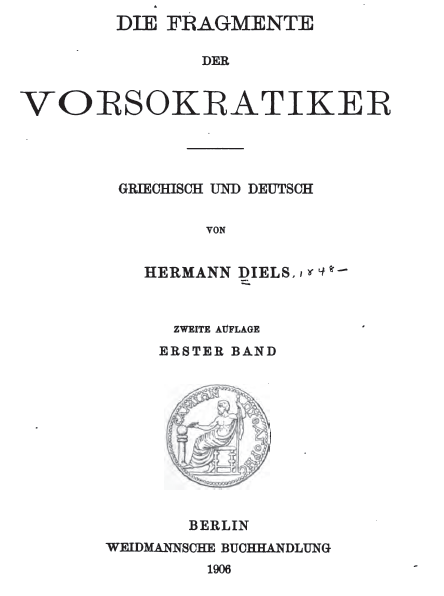
Hermann Diels: Die Fragmente der Vorsokratiker (1906)

http://remacle.org/bloodwolf/philosophes/thales/table.2.gif

Hermann Diels: Die Fragmente der Vorsokratiker (1906)

Read more...

ξῡνός (Xynos), κοινός (koinos)

ξῡνός, ή, όν, (ξύν) older form of κοινός, common, public, general, concerningor belonging to all in common, [Ιλιάς]; γαῖα ξυνὴ πάντων earth the commonproperty of all, Ib.; ξ. Ἐνυάλιος, i.e. war hath an even hand, is uncertain, Ib.; ξ. πᾶσι ἀγαθόν [Ηρόδοτος]; ξυνὰ λέγειν to speak for the common good, [Αισχύλος]
Source: Greek-English on-Line Lexicon

Read more...

The fragments of the work of Heraclitus of Ephesus on nature; translated from the Greek text of Bywater (1889)


The fragments of the work of Heraclitus of Ephesus on nature; translated from the Greek text of Bywater, with an introd. historical and critical (1889)

Read more...

Heraclito, El hombre dormido y el hombre despierto

[heraclito.jpg]
VILLA, Mariano Moreno. Filosofía (enseñanza secundaria) Vol. III p. 348 ;)

Read more...

The fragments of Heraclitus - The G.W.T. Patrick translation (1889)

link

95

Plutarchus, de Superst. 3, p. 166: ὁ Ἡράκλειτός φησι, τοῖς ἐγρηγορόσιν ἕνα καὶ κοινὸν κόσμον εἶναι, τῶν δὲ κοιμωμένων ἕκαστον εἰς ἴδιον ἀποστρέφεσθαι.
Plutarch, de Superst. 3, p. 166: Heraclitus says: To those who are awake, there is one world in common, but of those who are asleep, each is withdrawn to a private world of his own.

Read more...

Lorem Ipsum

"All testing, all confirmation and disconfirmation of a hypothesis takes place already within a system. And this system is not a more or less arbitrary and doubtful point of departure for all our arguments; no it belongs to the essence of what we call an argument. The system is not so much the point of departure, as the element in which our arguments have their life."
- Wittgenstein

Lorem Ipsum

"Le poète ne retient pas ce qu’il découvre ; l’ayant transcrit, le perd bientôt. En cela réside sa nouveauté, son infini et son péril"

René Char, La Bibliothèque est en feu (1956)


  © Blogger template Shush by Ourblogtemplates.com 2009

Back to TOP